


Living Organic Online Store
Organic Farming Books


The Winter Harvest Handbook: Year-Round Vegetable Production Using Deep-Organic Techniques and Unheated Greenhouses
Choosing locally grown organic food is a sustainable living trend thatas taken hold throughout North America. Celebrated farming expert Eliot Coleman helped start this movement with "The New Organic Grower" published 20 years ago. He continues to lead the way, pushing the limits of the harvest season while working his world-renowned organic farm in Harborside, Maine.Now, with his long-awaited new book, "The Winter Harvest Handbook," anyone can have access to his hard-won experience. Gardeners and farmers can use the innovative, highly successful methods Coleman describes in this comprehensive handbook to raise crops throughout the coldest of winters.Building on the techniques that hundreds of thousands of farmers and gardeners adopted from "The New Organic Grower" and "Four-Season Harvest," this new book focuses on growing produce of unparalleled freshness and quality in customized unheated or, in some cases, minimally heated, movable plastic greenhouses.Coleman offers clear, concise details on greenhouse construction and maintenance, planting schedules, crop management, harvesting practices, and even marketing methods in this complete, meticulous, and illustrated guide. Readers have access to all the techniques that have proven to produce higher-quality crops on Colemanas own farm.His painstaking research and experimentation with more than 30 different crops will be valuable to small farmers, homesteaders, and experienced home gardeners who seek to expand their production seasons.A passionate advocate for the revival of small-scale sustainable farming, Coleman provides a practical model for supplying fresh, locally grown produce during the winter season, even in climates where conventional wisdom says it ajust canat be done.a
Molly's Organic Farm
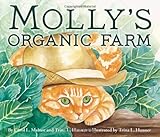
Whoosh . . . the wind blows open a creaky gate. Inquisitive and mischievous, a homeless little cat scampers through—and suddenly finds herself in the wondrous world of an organic farm! Affectionately named "Molly" by the farmers who discover her, she romps, naps, and hunts among the vegetables. Seen through Molly's eyes, the reader discovers the interplay of nature that grows wholesome food. But what will happen to Molly when winter comes? Based on a true story, Molly will touch children's hearts while introducing them to plants and the key elements of growing food organically. Standards-based science concepts and activities at the end of the book expand the message of the story.
The Self-Sufficient Life and How to Live It
The Self Sufficient Life and How to Live It is the only book that teaches all the skills needed to live independently in harmony with the land harnessing natural forms of energy, raising crops and keeping livestock, preserving foodstuffs, making beer and wine, basketry, carpentry, weaving, and much more. Our 2003 edition included 150 new full-color illustrations and a special section in which John Seymour, the father of the back to basics movement, explains the philosophy of self-sufficiency and its power to transform lives and create communities. More relevant than ever in our high-tech world, The Self Sufficient Life and How to Live It is the ultimate practical guide for realists and dreamers alike.
Farming and Gardening for Health or Disease
Sir Albert Howard presents a summary of his life's work in this book. Howard states "This law is true for soil, plant, animal, and man: the health of these four is one connected chain. Any weakness or defect in the health of any earlier link in the chain is carried on to the next and succeeding links, until it reaches the last, namely, man." Howard's work, decades ahead of its time, provides an insight into how he realized the value of organic methods though he went to India intending to teach the use of chemical fertilizers and chemical pest control.This text has been published under the title "The Soil and Health" and also under the title "Farming and Gardening for Health or Disease."
The Winter Harvest Handbook: Year Round Vegetable Production Using Deep-Organic Techniques and Unheated Greenhouses
Choosing locally grown organic food is a sustainable living trend that’s taken hold throughout North America. Celebrated farming expert Eliot Coleman helped start this movement with The New Organic Grower published 20 years ago. He continues to lead the way, pushing the limits of the harvest season while working his world-renowned organic farm in Harborside, Maine.Now, with his long-awaited new book, The Winter Harvest Handbook, anyone can have access to his hard-won experience. Gardeners and farmers can use the innovative, highly successful methods Coleman describes in this comprehensive handbook to raise crops throughout the coldest of winters.Building on the techniques that hundreds of thousands of farmers and gardeners adopted from The New Organic Grower and Four-Season Harvest, this new book focuses on growing produce of unparalleled freshness and quality in customized unheated or, in some cases, minimally heated, movable plastic greenhouses.Coleman offers clear, concise details on greenhouse construction and maintenance, planting schedules, crop management, harvesting practices, and even marketing methods in this complete, meticulous, and illustrated guide. Readers have access to all the techniques that have proven to produce higher-quality crops on Coleman’s own farm.His painstaking research and experimentation with more than 30 different crops will be valuable to small farmers, homesteaders, and experienced home gardeners who seek to expand their production seasons.A passionate advocate for the revival of small-scale sustainable farming, Coleman provides a practical model for supplying fresh, locally grown produce during the winter season, even in climates where conventional wisdom says it “just can’t be done.”
Organic Marin: Recipes from Land to Table
"Now more than ever, we need to make decisions about cooking and eating that support the kind of agriculture that takes care of the land we hold in trust for future generations. This beautiful book, full of recipes for delicious, seasonal meals, is a tribute to the Marin County farmers, artisans, and cooks who uphold that stewardship and provid for our future." --Alice Waters, Chez Panisse Restaurant "Organic Marin" gives you a taste of what has become one of America's most vibrant local food scenes; indeed, this beautiful book is the next best thing to eating there." --Michael Pollan, author of "The Omnivore's Dilemma and In Defense of Food" "Every society is a direct reflection of the status of its soil . . . Everything comes from soil. We are nothing without it." --Helge Hellberg, executive director of Marin Organic "Organic Marin" is more than a regional cookbook. It also represents an organic movement reverberating around the globe, demanding a more thoughtful, less wasteful approach to life. The connection between field and farmer, land and table, and food and family translates to the passionate belief that food fosters community. And nowhere is this connection more apparent than in Marin County, California, the birthplace and standard-bearer of American organic farming. In "Organic Marin," 16 of America's most esteemed organic farms share their stories and philosophies alongside 50 mouthwatering organic recipes organized by season and contributed by 25 of the San Francisco Bay Area's most popular organic restaurants. With recipes for Heirloom Tomato Flat Bread, Seared Ahi Tuna with Asian Slaw, Chicken Fra Diavolo with Fennel and Dandelion Salad, Double ChocolateBread Pudding, and much more, anyone can create the delicious dishes featured in this beautiful and inspiring organic cookbook. Proceeds of "Organic Marin" support Marin Organic's school lunch program, which serves 12,000 lunches a week with food grown in Marin County.
The Omnivore's Dilemma: A Natural History of Four Meals
The bestselling author of "The Botany of Desire" explores the ecology of eating to unveil why we consume what we consume in the twenty-first century "What should we have for dinner?" To one degree or another this simple question assails any creature faced with a wide choice of things to eat. Anthropologists call it the omnivore's dilemma. Choosing from among the countless potential foods nature offers, humans have had to learn what is safe, and what isn't-which mushrooms should be avoided, for example, and which berries we can enjoy. Today, as America confronts what can only be described as a national eating disorder, the omnivore's dilemma has returned with an atavistic vengeance. The cornucopia of the modern American supermarket and fast-food outlet has thrown us back on a bewildering landscape where we once again have to worry about which of those tasty-looking morsels might kill us. At the same time we're realizing that our food choices also have profound implications for the health of our environment. "The Omnivore's Dilemma" is bestselling author Michael Pollan's brilliant and eye-opening exploration of these little-known but vitally important dimensions of eating in America. Pollan has divided "The Omnivore's Dilemma" into three parts, one for each of the food chains that sustain us: industrialized food, alternative or "organic" food, and food people obtain by dint of their own hunting, gathering, or gardening. Pollan follows each food chain literally from the ground up to the table, emphasizing our dynamic coevolutionary relationship with the species we depend on. He concludes each section by sitting down to a meal--at McDonald's, at home with his family sharing a dinner from Whole Foods, and in a revolutionary "beyond organic" farm in Virginia. For each meal he traces the provenance of everything consumed, revealing the hidden components we unwittingly ingest and explaining how our taste for particular foods reflects our environmental and biological inheritance. We are indeed what we eat-and what we eat remakes the world. A society of voracious and increasingly confused omnivores, we are just beginning to recognize the profound consequences of the simplest everyday food choices, both for ourselves and for the natural world. "The Omnivore's Dilemma" is a long-overdue book and one that will become known for bringing a completely fresh perspective to a question as ordinary and yet momentous as What shall we have for dinner?
Successful Small-Scale Farming: An Organic Approach (Down-To-Earth Book)
Offering proven techniques and practical advice, this inspiring handbook covers all aspects of successfully running a small organic farm. With expert tips on everything from buying land to creating a niche market for your products, Karl Schwenke shows you how to naturally enrich your soil, acquire necessary equipment, consistently grow abundant crops, and manage farm finances. You’ll enjoy learning essential skills like haying and fencing as you turn your organic farming dream into a profitable reality.
The Organic Gardener's Handbook
In a handy, illustrated format, this reference book studies all aspects of organic farming, from the basics of climate, geology, and soils, to an explanation of plants and their orders. The guide also explores planning and planting methods, including strip cropping and crop rotation; protection for a variety of vegetables and edible plants; companion planting and biological control; plant pests, barriers, and deterrents; and weed management. Particular attention is paid to improvements to the soil, fertilizers, minerals, compost, and manures. Complete with a list of tasks and monthly reminders, an extensive glossary, and useful contacts, this resource provides reputable advice for all gardening aficionados.
The Organic Farmer's Business Handbook: A Complete Guide to Managing Finances, Crops, and Staff - and Making a Profit
Contrary to popular belief, a good living can be made on an organic farm. What’s required is farming smarter, not harder. In The Organic Farmer’s Business Handbook, Richard Wiswall shares advice on how to make your vegetable production more efficient, better manage your employees and finances, and turn a profit. From his twenty-seven years of experience at Cate Farm in Vermont, Wiswall knows firsthand the joys of starting and operating an organic farm—as well as the challenges of making a living from one. Farming offers fundamental satisfaction from producing food, working outdoors, being one’s own boss, and working intimately with nature. But, unfortunately, many farmers avoid learning about the business end of farming; because of this, they often work harder than they need to, or quit farming altogether because of frustrating—and often avoidable—losses. In this comprehensive business kit, Wiswall covers: Step-by-step procedures to make your crop production more efficient Advice on managing employees, farm operations, and office systems Novel marketing strategies What to do with your profits: business spending, investing, and planning for retirement A companion CD offers valuable business tools, including easy-to-use spreadsheets for projecting cash flow, a payroll calculator, comprehensive crop budgets for forty different crops, and tax planners.
Tomorrow's Table: Organic Farming, Genetics, and the Future of Food

By the year 2050, Earth's population will double. If we continue with current farming practices, vast amounts of wilderness will be lost, millions of birds and billions of insects will die, and the public will lose billions of dollars as a consequence of environmental degradation. Clearly, there must be a better way to meet the need for increased food production. Written as part memoir, part instruction, and part contemplation, Tomorrow's Table argues that a judicious blend of two important strands of agriculture--genetic engineering and organic farming--is key to helping feed the world's growing population in an ecologically balanced manner. Pamela Ronald, a geneticist, and her husband, Raoul Adamchak, an organic farmer, take the reader inside their lives for roughly a year, allowing us to look over their shoulders so that we can see what geneticists and organic farmers actually do. The reader sees the problems that farmers face, trying to provide larger yields without resorting to expensive or environmentally hazardous chemicals, a problem that will loom larger and larger as the century progresses. They learn how organic farmers and geneticists address these problems. This book is for consumers, farmers, and policy decision makers who want to make food choices and policy that will support ecologically responsible farming practices. It is also for anyone who wants accurate information about organic farming, genetic engineering, and their potential impacts on human health and the environment.
The Quarter-Acre Farm: How I Kept the Patio, Lost the Lawn, and Fed My Family for a Year
When Spring Warren told her husband and two teenage boys that she wanted to grow 75 percent of all the food they consumed for one yearand that she wanted to do it in their yardthey told her she was crazy.She did it anyway.The Quarter-Acre Farm is Warren’s account of decidingdespite all resistanceto take control of her family’s food choices, get her hands dirty, and create a garden in her suburban yard. It’s a story of bugs, worms, rot, and failure; of learning, replanting, harvesting, and eating. The road is long and riddled with mistakes, but by the end of her yearlong experiment, Warren’s sons and husband have become her biggest fansin fact, they’re even eager to help harvest (and eat) the beautiful bounty she brings in.Full of tips and recipes to help anyone interested in growing and preparing at least a small part of their diet at home, The Quarter-Acre Farm is a warm, witty tale about family, food, and the incredible gratification that accompanies self-sufficiency.
The Complete Guide to Organic Livestock Farming: Everything You Need to Know about Natural Farming on a Small Scale (Back-To-Basics Farming)
Small scale farming has grown greatly in popularity during the last two decades, with a greater turn in public awareness toward locally grown, organic, grass fed products that have not been modified, chemically altered, or poorly fed. For that reason, those looking to start a small scale farm and raise livestock have a greater chance than ever before to take advantage of the new market for small scale goods. This book will show any potential small scale farmer how to start raising their livestock and marketing it to the organic, natural lifestyle community that so fervently seeks out these products. You will learn how to start the basic outline for your new small farm, including which livestock to raise, how to build their pens and habitat, and what you will be feeding them to maintain a healthy, organic farm. You will learn the basics of animal husbandry, from genetics and breeding to feeding, building locations, and proper health and reproduction care. You will learn how to find yourself in the right niche for selling your products and what legalities you must see to as well as the butchering and processing phase Hundreds of hours of in-depth interviews have been conducted for this book with top experts in farm management to provide you with details about farm planning, financial planning, and proper livestock planning. A complete appendix will detail the various breeds and needs of cattle, chickens, goats, horses, pigs, and sheep to help you select the right livestock for your farm. In addition, you will learn the basic composition of most feeds, different grasses and legumes you can use, and find a plethora of outside resources to utilize. For anyone with dreams of a small farm and raising livestock in their future, this is a book for you.
Organic Farming: Everything You Need to Know
Going organic may be a clear way of getting back to basics—and getting away from the havoc chemicals can wreak on our health and our environment—but the basics themselves may not be so clear. How to begin? What kind of fertilizer and feed are allowed? Is there natural pest management? What does certification entail? And is this the way to go? This book covers the basics and then some. Whether you’re thinking of starting an organic farm or making the transition to organics, whether you’re growing crops or raising animals, you’ll find everything you need to know in these pages—from getting started to developing a marketing strategy. A list of resources also points the way to other books, websites, and organizations focusing on every aspect of organic farming, including state standards and more information.
Great Growing at Home: The Essential Guide to Gardening Basics
In this book readers will discover how to grow the tastiest vegetables, most glorious flowers, improve their landscape to boost their property values and have gardens that are they envy of the neighborhood. The book is an easy-to-follow compilation of gardening know-how in one convenient volume by a nationally-recognized and acclaimed veteran garden writer. Top arborists, horticulturalists, plant breeders and other experts shared their knowledge and advice which Swenson has assembled in this fact-filled book. Great Growing at Home will answer all your gardening questions on such disparate subjects as container gardening and field layering, pruning and raised beds, compost bins and crop rotation, to name just a few. Written with a bias toward organic gardening as a result of his studies at the famous Rodale Farm in Emmaus, Pennsylvania, Swenson presents natural, organic gardening as a practical, productive and wholesome approach to producing an abundant, nourishing, and flavorful food supply. The book not only reflects his 40+ years as a garden writer, but also the first time he has been able to assemble his accumulated knowledge of gardening in one convenient place, including the latest information on new vegetable hybrids that resist disease and repel insects. Whether it's how to attract birds and butterflies to your garden or planting on slopes, Great Growing at Home will be your indispensable source of all you need to know about gardening.
Fresh Food from Small Spaces: The Square-Inch Gardener's Guide to Year-Round Growing, Fermenting, and Sprouting
Books on container gardening have been wildly popular with urban and suburban readers, but until now, there has been no comprehensive "how-to" guide for growing fresh food in the absence of open land. Fresh Food from Small Spaces fills the gap as a practical, comprehensive, and downright fun guide to growing food in small spaces. It provides readers with the knowledge and skills necessary to produce their own fresh vegetables, mushrooms, sprouts, and fermented foods as well as to raise bees and chickens—all without reliance on energy-intensive systems like indoor lighting and hydroponics. Readers will learn how to transform their balconies and windowsills into productive vegetable gardens, their countertops and storage lockers into commercial-quality sprout and mushroom farms, and their outside nooks and crannies into whatever they can imagine, including sustainable nurseries for honeybees and chickens. Free space for the city gardener might be no more than a cramped patio, balcony, rooftop, windowsill, hanging rafter, dark cabinet, garage, or storage area, but no space is too small or too dark to raise food. With this book as a guide, people living in apartments, condominiums, townhouses, and single-family homes will be able to grow up to 20 percent of their own fresh food using a combination of traditional gardening methods and space-saving techniques such as reflected lighting and container "terracing." Those with access to yards can produce even more. Author R. J. Ruppenthal worked on an organic vegetable farm in his youth, but his expertise in urban and indoor gardening has been hard-won through years of trial-and-error experience. In the small city homes where he has lived, often with no more than a balcony, windowsill, and countertop for gardening, Ruppenthal and his family have been able to eat at least some homegrown food 365 days per year. In an era of declining resources and environmental disruption, Ruppenthal shows that even urban dwellers can contribute to a rebirth of local, fresh foods.
Pesticide Drift and the Pursuit of Environmental Justice
The widespread but virtually invisible problem of pesticide drift--theairborne movement of agricultural pesticides into residential areas--has fueledgrassroots activism from Maine to Hawaii. Pesticide drift accidents have terrifiedand sickened many living in the country's most marginalized and vulnerablecommunities. In this book, Jill Lindsey Harrison considers political conflicts overpesticide drift in California, using them to illuminate the broader problem and itspotential solutions. The fact that pesticide pollution and illnesses associated withit disproportionately affect the poor and the powerless raises questions ofenvironmental justice (and political injustice). Despite California's impressiverecord of environmental protection, massive pesticide regulatory apparatus, andbooming organic farming industry, pesticide-related accidents and illnesses continueunabated. To unpack this conundrum, Harrison examines the conceptions of justicethat increasingly shape environmental politics and finds that California'sagricultural industry, regulators, and pesticide drift activists hold different, andconflicting, notions of what justice looks like. Drawing on her own extensiveethnographic research as well as in-depth interviews with regulators, activists, scientists, and public health practitioners, Harrison examines the ways industry, regulatory agencies, and different kinds of activists address pesticide drift, connecting their efforts to communitarian and libertarian conceptions of justice.The approach taken by pesticide drift activists, she finds, not only critiquestheories of justice undergirding mainstream sustainable-agriculture activism, butalso offers an entirely new notion of what justice means. To solve seeminglyintractable environmental problems such as pesticide drift, Harrison argues, we needa different kind of environmental justice. She proposes the precautionary principleas a framework for effectively and justly addressing environmental inequities in theeveryday work of environmental regulatory institutions.
Mini Farming: Self-Sufficiency on 1/4 Acre
Start a mini farm on a quarter acre or less, provide 85 percent of the food for a family of four and earn an income. Mini Farming describes a holistic approach to small-area farming that will show you how to produce 85 percent of an average family’s food on just a quarter acre—and earn $10,000 in cash annually while spending less than half the time that an ordinary job would require. Even if you have never been a farmer or a gardener, this book covers everything you need to know to get started: buying and saving seeds, starting seedlings, establishing raised beds, soil fertility practices, composting, dealing with pest and disease problems, crop rotation, farm planning, and much more. Because self-sufficiency is the objective, subjects such as raising backyard chickens and home canning are also covered along with numerous methods for keeping costs down and production high. Materials, tools, and techniques are detailed with photographs, tables, diagrams, and illustrations.